
I’ve run into the same brick wall enough times that my usually rather thick skulled motivation started to crack and I got enough of a headache that I had to take a step back.
The metaphorical wall in this case was my continuing inability to ever complete a work of fiction.
I’ve written at least fifty books. None of which are finished.
I’ve written at least a dozen novellas. None of which are finished.
I’ve written probably another fifty short stories. None of which are finished.
I can’t finish anything.
I’ve tried to power through many times. But it never works.
I hit the same wall and I keep cracking my skull.
In 2024 I finally took on enough damage to notice the pain of not getting anywhere.
I banned myself from writing fiction because it became obvious how lacking I was in basic writing skills.
So I made myself switch entirely to nonfiction to force myself to learn more basic and practical skills.
Because creative writing does not teach basic skills. The books on it don’t, the classes on it don’t.
Maybe it’s just how I learn that had me stuck. But I have written all my life and yet did not even begin to learn how to write until two years ago when I started practicing nonfiction.
Our individual creativity can be easily used to overcompensate for lacking the basic skills to function.
I’m a big fan of cooking and baking shows and those are very good examples of people trying to be overly inventive and unique to cover up what they’re missing in fundamental skill.
That is precisely what was happening to me with writing.
Nonfiction removes the ability to rely on creativity and gives something of substance to accomplish.
By substance I mean it has a clear use and function it must live up to. It can be objectively right or wrong.
There’s no fluffy clouds I get to float around on telling myself my own nonsense is my creativity.
All that being said, I still love my nonsense.
So!!
After two years of doing real work I decided I was ready for a vacation.
And it has been the summer of Norman,
Norman the Necromancer was the new book I started in 2024 and I loved it.
I was like oh, it’s going to be so good and so cool and I can just devote all my energy to it and this time I’ll finish it.
I got somewhere around ten thousand words or so (maybe twenty, I’m not sure) when I felt some logic knocking on my cracked skull and enough shame to stop.
Shame is not a fun emotion. But it can be incredibly useful.
Without my shame I’d be a totally insane human being so even though it’s an emotion I don’t like feeling it’s the emotion I’m most grateful for.
It helped me abandon Norman and my own delusions and gave me a chance to evaluate my true location in space and time and what really needs to be done if I ever hope to turn my abstract desires into practical results.
When I abandoned Norman I was still very motivated to write Norman. Motivation has never been my issue in life.
Many people have envied this in me but I’ve learned that motivation is usually hard to find for a reason.
Most things are a waste of time.
Highly motivated people like me can end up spinning our wheels in the same muddy hole until we run out of gas and end up trapped forever.
I’m sort of getting lost in tangents so I’ll refocus now.
I’ve had a full two years of rather hard work.
I gave up on fiction. I spent almost six months where I worked every single day at about seventy hours a week. I quit smoking and I contemplated my deeper terrors in life.
I decided I would face those deeper terrors. Strive for things I knew I might never achieve.
I got very, very serious for a bit is what I mean to say. I leaned into paying the piper.
I got dedicated to really just working hard and not expecting any relief.
Which was necessary. It did help improve my life.
But now I’ve reached a period where it’s time to relax just a wee bit.
Have a little vacation I suppose.
So I gave myself the summer off.
Which means I’m allowing myself to do as I feel and write fiction again for the fun of it.
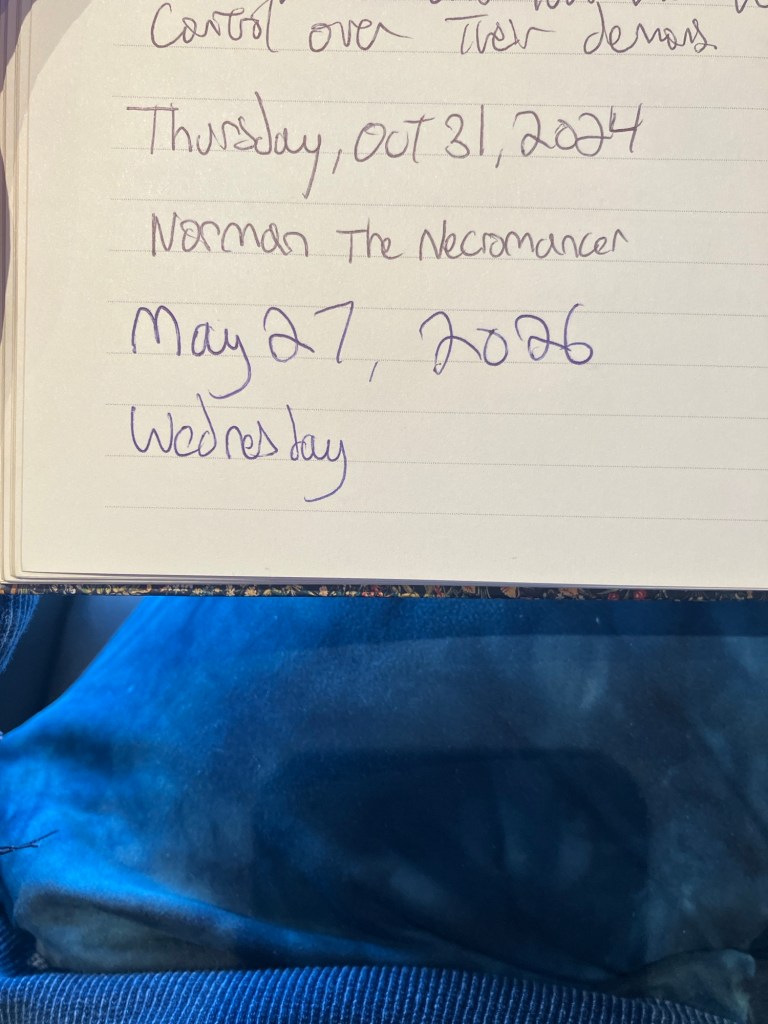
Norman was the perfect choice for my fiction vacation.
I was having fun writing it and I stopped writing it long before I got stuck in anyway.
I should give a wee bit of context on how I write fiction.
Different writers prefer different methods or perhaps a mix of different methods.
Some people for example like to carefully and painstakingly outline everything before they write anything.
That is not my method.
I’m the opposite.
I’m a chronic free writer.
Which means I like to sit down and write with no plans at all.
Or even thoughts or ideas or characters.
I just write the first thoughts that come to my mind.
Then I try to edit it all later.
In the past this method has produced mostly big globs of unintelligible chaos with some pieces of useable coherent plot.
I never noticed until I started looking over things again but over the years I was improving. My ratio of unintelligible chaos to useable coherent plot did start to even out.
But my two year break to only study writing nonfiction has made a huge difference in how I operate in my free writing.
I work much, much slower for example but nearly eighty percent of what I write ends up being useable.
It’s been very interesting because since I’m not trying to get anywhere or accomplish anything my habits have gotten a lot more ordered and less chaotic.
When I was desperately trying to accomplish a certain amount of writing or get a certain level of progress my writing was much more chaotic.
Below is everything on Norman the Necromancer that I’ve written since may 27th
You’ll notice it’s not very much.
Only about three thousand words if I remember correctly.
For context, at one point in my life (when I was at my most insane) I was writing ten thousand words a day.
And yet now in a full thirty days all I have written is three thousand words.
That seems like a slower pace but actually it’s just more efficient.
Instead of spending hours and hours writing unintelligible nonsense like I used to, I now spend thirty minutes here and there writing when I feel like it and it comes out actually readable.
I wrote probably about four thousand words in my unicorn notebook. Then left out what I didn’t care for when I typed it into my computer.
It’s nothing more than a little sketch of my thoughts on this book.
When I’m free writing it’s not really meant for other people to know what’s going on it’s meant for me to try to figure out what’s going on.
When I free write my goal is not to find overarching ideas. I free write to find the details and then I’ll edit to create a plot around the details.
That to me is the purpose of free writing. It’s not looking for the plot, it’s just slowing down thinking enough to see the little details of what is trying to be expressed or imagined.

In my first years hunting Necromancers as an apprentice I came across the lore of the coins.
My master accepted a request that took us down the mountain into those lands near its base. He didn’t speak much of what we were doing but I’d found my ways of reading him. I was only twenty and recently come to understand the importance of reading people. Most especially of reading my Master.
For my Master did not tell the truth and he had a particular lack of affection for me that made me develop skills I might not have had he even hinted at possessing any kindness towards me.
There was a look he got that I had become particularly wary of. It was a glint that warmed his eyes for a second before it faded out. I swear I could see the light shine on the surface of his old brown eyes then watch it fall in the dark circle that was the pupil and get trapped there and return his eyes to that which had no reflection.
It was the glint I saw him get when a girl’s dress got caught in between both sides of her bum and the outline of it became almost as clear as if she were naked. It was a glint I also saw when he watched a man bring an amber whiskey to his mouth and laugh as he wiped the excess from his lips.
We were men of the church after all. There were things we did not indulge in. My Master was very quick to punish the temptations in him so that they never even got out of his eyes. Let alone shown on his expression. But his treatment of me made me smarter, I caught the look in his eyes before he could bury it.
And I caught the look then. That glint in his eyes when the black and gold coins were mentioned. That was when I came to understand that the black and gold coins were something to be tempted by even if I didn’t yet know what the temptation was.
I knew there was little point in asking my Master questions but I asked them anyway. On most occasions in response to questions my Master did not wish to answer he would simply grunt. But on that occasion he struck me across my temple with the face of his silver ring and it effectively communicated to me that I must never ask that question again.
It was no trouble to me. My curious mind was curious about everything. Many things took my fancy as an apprentice. I was quite easily distracted by new information and it was other things I found to occupy myself. I forgot about the black and gold coins and didn’t remember them until a year after my Master died.
My new Master was a little better humored than my first. For instance he had no occasional glint in his eye. For his shined most the time. His philosophy on being a Necromancer hunter was not focused on being a disciplined man of the church. Instead he put his focus onto being a man that was likely to die young and thus he indulged himself.
Most times I was grateful for him. But there were some instances that made me miss my first Master. For my second had a level of recklessness that wasn’t preferable.
I sometimes credit my rise above my peers to my deeper interest in Necromancing techniques. I got quite curios on the details of how one controls a soul. I even wondered what a soul itself is to them.
Such things are not covered in the church. And why should they be? Those are the things one would study if they wanted to become a Necromancer. For those of us that hunt Necromancerswe need only know the simple facts.
For instance Necromancers need pieces of the body to find the soul in the underworld. The more experienced Necromancers can also use items of sentimental value to find the soul. One means of prevention is the burning of bodies and all worldly possessions. But it is not a complete prevention. For the truly powerful Necromancers can navigate the underworld on their own. They need nothing to find a soul.
There is only one type of soul they have no access to. In the scripts within the church they are called the silent souls. But no detail on them is shared.
So one is left with many questions. What is the underworld? What makes a soul silent? And why must a soul be loud in order to be vulnerable to Necromancers?
My frustration with all this had a reckless although rather clever idea. And I must tip my hat to rather bold younger self for his lunacy and tenacity.
You see there is a question I have been asked so often that I can see it on their lips before they say it. It’s very distinctive between men and women.
The women, their lips part and then clamp, then they fall completely away from each other and rather quiver in a way that is almost reminiscent of how my horse slaps his lips together when he is particularly bored or happy (I haven’t yet been able to distinguish between a horse’s happiness or boredom. If those emotions are even separate in them.) They then mumble out the words between pauses and breathiness.
The men however, their lips press together into a straight line and they clamp them so tight it seems to divert their attention from breathing and their faces turn red and the question falls out like an accusation.
“Is there a way for the soul to resist control?”
Of course in my early years of study I did attempt to research such a thing. Can a Necromanced soul resist control and gain its own agency?
This is not a subject that was much debated within the church. I knew only one such man that shared my sentiments. Blind old Edgar. Old Edgar cared for the study of this because he was one of the few that had seen a freshly risen soul. He found it adequately horrifying and drove him to this study.
Freshly risen souls were much different than those Necromancers use in battle. For they looked, acted, and sounded exactly as the people they’d been when they were alive.
From Edgar’s account the necromanced soul had control of its thought and mind upon being risen but not its body. Thus it attempted to resist the orders it was given. But there was a gradual agreement. Over time the soul began to respect the orders it was given and over more time it seemed to begin to think it was acting on its own whim and had no idea it was following any orders at all.
At that point the corpse would start to rot and it would begin to lose speech entirely. Then sometime after it becomes the troublesome spirits we all know. This is a rather horrifying fate for most to consider. The loss of their agency and their slow decay. A way to regain control or break free even if caught would be of extraordinary comfort and hope.
Of course I must admit that was not my motivation. My own curiosity was driving me and it pushed my ambition into the outskirts where there was no practical success. In my first few years as a graduated hunter the church felt my career was most promising but I fell rather far off anyone’s radar as I traveled farther and farther away from glory. Chasing my own theories in the waste lands no serious hunter would ever bother with.
It was something very specific I was looking for. Something that took a lot of skill and luck to find.
Something young and clumsy and all on its own. I preferred it be male so I would feel less in its torture. But I needn’t have worried. Necromancers were not known for their bravery nor their ability to withstand interrogation.
How did I find her?
Because she was young, clumsy and careless. Living in the desert and trying to pick off the dead of a town that had less fear of Necromancers because they’d had few encounters with them. She was trying to harvest her first souls.
A scrawny little thing, with hollow little cheeks, barely breaking her sixteenth winter. I found her skulking through the town looking for death.
At first it was her books I was most interested in. The texts of the Necromancers were fascinating. They were encoded of course. But as I said, Necromancers are easily intimated. I broke only one of her fingers (and not even a finger she particularly needed. The finger next to the pinky) and she gave me the key to the encryption.
To reward her and reinforce such cooperative behavior, I set her finger put her in a cage off in a corner with a bottle of local whiskey and a good meal of fat red grapes and loaf made from barely.
She rocked herself in the corner cradling her whiskey and her loaf and softly whimpered to herself. (Over time I came to realize the mark of the greatest Necromancer’s was often the degree of their cowardice. So I should not have underestimated her as much as I did.)
The text she gave me was complex. Far more complex than any we possessed in the church and most of what was written in it alluded to things one obviously had to have the knowledge of a Necromancer to understand. But there was a particular passage on souls that seemed worth further inquiry.
So I went to the whimpering, sunken little thing and I asked her. “This text seems to imply that there are two parts to a soul. Am I understanding that correctly?”
Her lips flapped together (much like my horse, Sir Grayson) and she drooled out them as she tried to quiver out words. Quite dramatic. As I said, I only broke one of her fingers. Necromancers surely were a delicate type.
“You have been very accommodating, if I must break another finger I’ll allow you to choose which one.”
Her lips stopped quivering. She cradled her bread to her face like a mother might a new born and then she nodded and spoke rather calmly and rationally. Which was quite a switch. “Yes sir. You understood that correctly. Would you like me to elaborate?”
“Yes, that would be quite appreciated. What is this soul animus and soul anima?”
She quaked a bit and sniffled. Then cradled the whiskey to her face next, returning to calm and rational. “They are old words sir. One means that which responds and the other means that which is.”
I ruffled through my belongings for more luxury items and found an old dried bit of cow flesh and tossed it to her. She didn’t cradle that. That she ripped into like an animal and I continued my study.
I did not grasp what was written in one day. It was not only encoded, it was also tailored to be read by someone that already had knowledge in necromancy. But it was easy to see that it was explaining concepts and a way of thinking I’d never before considered. So it was rather mesmerizing and difficult to turn away from.
As well as impossibly frustrating to understand and I was very impatient to understand. I had to threaten to break more fingers and even a few toes, and at a point the little necromancer girl got so frightened she turned to hysterically shrieking in the corner. At which point I threatened to set her ablaze with the book and leave them both to burn.
She calmed down when I held fire to her foot and we had another rational conversation in which she explained how Necromancers don’t control souls. Such a thing is impossible. Nor can they control the outer part of the soul which they call the animus, the ‘that which responds’. What they do, do, is search for those souls that have their ‘that which is’ and ‘that which responds’ separated enough that they can set the ‘that which responds’ in a little trap.
It’s all very clever. A delicate practice and lends to why necromancy takes so many years to become adept at. One might almost consider it an art form.
I’m not sure I’m doing it justice or explaining it correctly. One might imagine the animus, the ‘that which responds’ as that which guards the soul. The monster in it so to speak. This beastly part of the soul that keeps the rest of the soul intact. It separates in times of particular danger or particular opportunity. It stands to reason, as I understand it, that an unseparated animus and anima are what the church texts are describing when they refer to a ‘silent soul’.
And thus a separated animus and anima would result in the opposite. The ‘loud’ souls (as I call them. The texts only reference silent souls) are those souls that have their beasts out and about.
To separate the beast from its soul it must be made to feel in mortal danger or it must be made ‘too happy’ (that is how she described it. Too happy. I don’t know yet what that means. What pleases a soul?).
The danger or the happiness must be significant enough that it crystalizes. Much like diamond forms in the high pressures of the earth. Such a crystal usually needs repeated offense. Not one event but multiple events. As she described it, that is what the necromancers search out in the depths of the underworld. These crystals. In that way they can trap the animus its place and run the beast in a loop of its own past.
I then searched my focus for a moment and tried to have her explain what the underworld is and how it was entered. But it was either something too complex for my untrained mind to understand or the girl got clever and confused me enough to overwhelm me and turn my attention back to what she didn’t mind revealing.
After I exhausted her with my questions on the soul and she had gained quite a different personality in the comfort of realizing I was unlikely to break anymore of her fingers (she got quite a bit ruder) I turned my mind to my real intentions with her.
I wished to see freshly risen souls.
 Jess lanai
3 responses to “The summer of Norman”
I hope you finish this story. It seems that you really enjoy writing it. Maybe you could try creating a storyboard to help you with sequencing and create a proper ending for Norman.
LikeLiked by 1 person
That’s a good idea, I think first I need to find a plot though 😅😅😅 right now it’s just random stuff very little of which ties together. It’ll take me probably at least a few years to even get a solid plot 😅😅😅
LikeLike
you have a skill,I can’t believe you have not been published ……I’d like to read more TC
LikeLike