

This should be the final post before the main post that ties all the facts together and leads to my messy final conclusion.
Should be. We’ll see if I can pull off going through the rest of my notes in this one post.
When I started this ASMR studying thing it was simply yet another desperate attempt.
I’ve made many, many, many desperate attempts. I have pretty detailed records on all of them. Hundreds and hundreds and hundreds of pages that probably get into the thousands if I tried to add them up.
Definitely into the millions on word count.
What was the desperate attempt?
To finish something.
I have many hard drives full of writing I’ve never finished. Because I could not figure out how to ever finish anything.
However clumsy this blog has been, these posts are still the first things I have finished.
I’m starting to get knack for how to handle myself. How to manage and organize myself so that things actually get accomplished and I can achieve some level of productivity.
It’s even possible that I’ve reached a very high level of productivity. I haven’t bothered to compare myself to others. Only to myself.
And compared to my old self my productivity is astronomical.
That is why this blog has become very addicting. And why this blog is valuable to not only me but to other people.
Because I’m a giant chaotic ball of mess. If I can figure out how to untangle myself then the people that are better than me definitely can.
And lots and lots of people are much better than me.
And this blog is the actually somewhat intelligible record of how I doing it.

When I finally accepted that I was incapable of ever finishing any fiction, I turned to nonfiction.
I wasn’t good at finishing that either, so I then instead turned to research.
From learning how to research I realized that the reason I can’t finish anything is because I don’t know anything.
I was trying to talk about things I don’t know anything about. I didn’t know how to ask questions. How to ask for help or how to collaborate with people when it came to my ideas.
(My poor childhood best friend saw the worst of me with that. )
Learning how to research is a very good way to learn all that. How to ask questions. How to ask for help. How to collaborate with other people and let them fill in the gaps that you may be incapable of filling yourself.
I researched quite a few things before I finally figured out how to get some coherency.
ASMR is simply the first thing I stuck with and completed. Completed to enough of a degree at least.
To most people it still might come off very messy, incomplete or even incorrect. But for me it’s an incredible improvement. And I’m not yet any where near how much I can improve now that I’ve gained a little traction.
That’s what keeps this blog very motivating. I can see how much better I will get and I I like having this messy record of gradual improvements.
The nucleus accumbens.
This was the hardest part of the brain for me to get through. I had employ quite a bit of will power (top down rationality) to read about this part of the brain.
Most of the papers I forced myself to read about the nucleus accumbens were studies on its role in addiction. Because the nucleus accumbens is the part of the brain that eats up all the oxygenated blood (BOLD signal) when it’s anticipating a reward.
This lead me to the studies on glutamate homeostasis which fell into a tangent that I’m not sure is necessary to go into. So I’m going to move on from it for now.
One of the papers I read (once again I’ll list all papers I read in the final post) went over a study that showed how the nucleus accumbens anticipates reward but it does not anticipate punishment.
That helped make it more distinct in my mind as something that functions for motivation towards reward. Not for motivation to avoid punishment.
Which made me think of more specific questions.
Which led me to another study that I found very interesting on how the nucleus accumbens enforces safety signals.
This was cool to me.
The NA will keep focus on the anticipation of the reward by reinforcing safety signals and therefore avoiding (ignoring) negative emotions that lead to stress.
I found that very interesting. Because it made a lot of sense to me.
Negative emotions do rather fade away when I’m in the process of being highly engaged in something. That I’ve always known.
When I was younger I watched a lot of anime and played video games. My nucleus accumbens was definitely fully engaged in those activities and it did help me avoid feeling stressed.
But I’d never thought of the mechanisms functioning in that particular way. That stress is more easily avoided because the cues of safety are being reinforced.
I fell into a little tangent trying to understand more specifically how the nucleus accumbens does this and went down a messy little road of trying to understand the difference between a relief memory and a safety memory. (I might go into that later but it would require a lot more study)
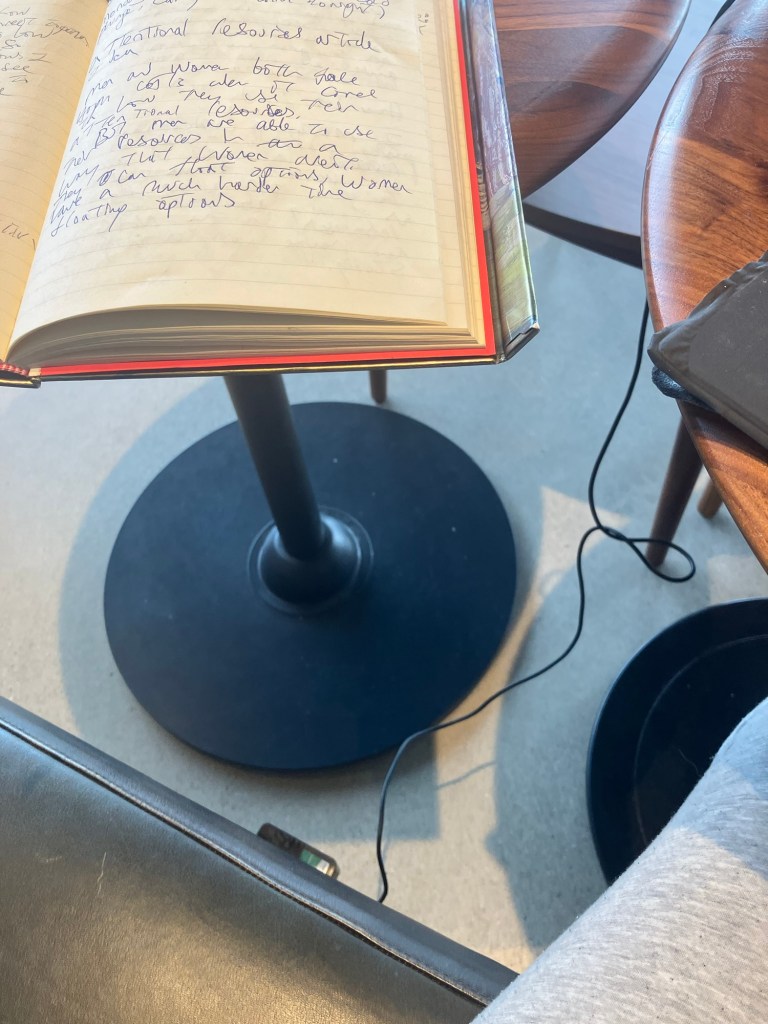
Then I found this strange note in my silver bitches notebook that was headed as ‘attentional resources’
It reads, ‘men and women both face high cost when it comes to how they use their attentional resources, but men are able to use their resources in a way that women aren’t. Men can float their options, women have a much harder time floating options’
I have no idea where this came from, I didn’t mark where I read it or why I read it or what it had to do with anything.
But I thought it was an interesting note.
No idea of course if it’s true or not.

The bilateral insular cortices are the part of the brain that I found most interesting.
Because I had a kind of instinctual understanding of how they worked that was being translated back to me through reading the science of it.
Which I found fascinating. I think all human beings do have some intuitive understanding of a lot of this stuff. Science just translates it in a way that we don’t recognize. (Just my own personal theory)
The bilateral insular cortices play a huge role in empathy and also in processing sound.
But I have failed. I can’t get through all my notes in this one post.
I’ll have to get to the bilateral insular cortices in the next ASMR post.
Why?
Why can’t I finish it in this post?
Because this is one of the ways I’ve learned to manage myself so things actually get done and small accomplishments do start to compound and turn into real things.
One way I now get things done is by not getting things done. By letting them be unfinished and incomplete and putting them out there anyway.
Because it keeps things from remaining too internal. It opens things up to discussion, criticism and feedback which is always helpful.
And it makes me be where I’m at. I have to acknowledge I don’t know exactly what it is I’m doing and that I have a longer road ahead. And that maybe all I’m able to do in this moment is understand one aspect of one thing a tiny bit better than I did before.
Or even that the best I can do is know I don’t understand something at all but at least I have my lack of understanding to go on and I can think about the specific thing I don’t understand. Which can lead me to the right question to ask.
 Jess lanai
8 responses to “ASMR: the outer layers”
Very interesting Jess.
I think about it often- how in order to engage in exploration, we first have to feel safe. Safety can come bottom up (comforting activity like the anime for you), but I’d argue we must have at least little top down safety otherwise our BAS (Behavioral approach system) won’t activate from first place.
Regarding what you said about negative emotions fade away while you’re highly engaged- High approach state tends to narrow cognition. The more aroused you are, the more activated your emotions- the more your brain going to tune out anything else. High approach states lead to memory biases, time preference shift, risk perception change, and also sometimes reduce intrinsic motivation and reduce creativity, as you trying the fastest way to obtain a certain reward. Sometimes it’s good but not always.
I try to keep many times what I call “low approach motivation”, this way my arousal level is way more optimal and I become less “blind” due to too much focus on one stimuli.
Regarding attentional resources, I recommend reading about the working memory theory of Baddeley and executive control functions (shifting, inhibiton, updating). I also recommend Michael Eysenck work. He has a book about how emotional states affects attention.
LikeLiked by 1 person
I think you might’ve gone a bit over my head 🤣 I’m new to all of this I only know some of what you are talking about.
I’m not sure what you mean by ‘top down safety’ for example. I know for the safety cues I was thinking of it reinforcing like little unconscious cues to help us zone out.
But I’m not sure what top down safety is, do you mean like, a more conscious type of awareness?
LikeLike
Yeah fair 😅 I sometimes go a bit too conceptual
I think we were actually talking about two different kinds of safety- you meant more like activities, and I was thinking more about people.
What you described is more like getting immersed in something and stress just fades.
I was thinking more about how when you feel safe with someone, it kind of becomes a base that everything else builds on and calms your system before anything even happens. It’s similar to the idea of a ‘secure base’ in developmental psychology.
It’s not really a conscious thing- more like something that’s operating in the background. I think I said top-down, because over time it becomes internal, like expectations about the world… does that make sense?
I now wonder if those two kinds of safety reinforce each other or compete.
Personally I feel like I can switch between them depending on my mood, but sometimes activity based comfort can turn into a bit of an escape and make me less motivated to seek connection.
At the same time, I guess if you feel really safe in a relationship, you’d probably rely less on those kinds of activities.
So don’t blame me blame the world 🤓
LikeLiked by 1 person
Okay now I get what you mean. I definitely automatically feel safer when I’m in a relationship. Of even just when there’s a guy around that I like or trust in some way.
Or if I have good friends near me I also automatically feel safer.
That’s actually what I’m going to get to on this whole ASMR that’s my whole point 🤣 I haven’t gotten to it yet but it’s basically what this whole thing leads up to.
How social bonding relieves a lot of pressure and makes us feel safer and calmer. So you stole my punch line! 🤣 I’ll write about it anyway though
LikeLike
I actually looked into ASMR a while back and came across something that felt almost anthropological to me. It was on a forum- a group of women who seemed really drawn to this kind of content. I remember thinking, “Wait a second what’s going on here! It’s like crack for them” lmao. It reminded me a bit of the way porn affects men. I remember feeling like I’d stumbled onto something- and honestly I found it kind of sexy and cute seeing women so openly into it. It was also an all-women environment, so I guess inhibitions were lower. Of course… maybe they were all Indian men haha
I don’t know how representative that is overall, but that was my impression at the time. I hadn’t really thought about it the way you described, tbh- it’s an idea worth exploring whether ASMR might actually help regulate the nervous system. For those women I talked about, I guess it felt more stimulating than calming.
I know in social contexts, cues like voice, tone, and presence can activate what’s sometimes called the ventral vagal state- a more calm, connected mode (as opposed to fight or flight or shutdown). I guess ASMR kind of mimics some of those cues artificially, which might explain why it can feel regulating or even like a form of co regulation.
LikeLiked by 1 person
I definitely can’t considered it crack for myself. I mostly started studying it because I thought it was so bizarre that we have these AI ASMR videos out there that are so popular and I just wanted to know how it became a thing.
I do like the cutting sand stuff out there or the slim videos which is sort of ASMR but not really.
But what I am a little dependent on sounds. Like, I have sounds for studying and sounds for sleeping and all that. It’s different than ASMR but the science behind it is kind of similar and it’s very interesting.
I got into using sounds to study because of studying this ASMR thing and it’s changed my life. I can’t believe how much easier it’s made everything for me,
LikeLike
Oh, I get you. It sounds much more like you’re using it as a tool, especially with the studying/sleep stuff. But I feel like we might be talking about different sides of it.
There’s also that more… interpersonal version of ASMR, where it feels less like background sound and more like simulated interaction.
I just searched it again so you can see- imagine you’re some kind of sociological observer for a second and focus on the comments. Is it just me, or does the engagement feel way more intense than you’d expected?
https://www.reddit.com/r/gonewildaudio/s/i10o8a08zj
LikeLike
Unfortunately it’s not letting me open it without an account so I can’t see it
LikeLike