
This post is going to be a messy gathering of my notes as I figure out what I learned and how to organize the things I learned. Possibly even make a coherent thought out them.
The organization of learning is very important.
Because I find it very hard to learn things in order.
If I come across something I completely do not understand and then I make the attempt to understand it, often it won’t work and I’ll have to move on to something else.
But then I’ll be studying something else and that something else makes me understand the other thing I didn’t understand, even if they are unrelated.
Translating all these strange associations into linear thought that another human being can logically follow is not easy.
It’s not easy for anyone. But it’s a good exercise whether or not a person wants to be writer because it can deepen understanding not only of the thing but of the process. And then, even when something is very difficult, the process can break up it up into tiny little pieces that are easily managed.
What this post is not going to be is a perfect account of information. A lot of the stuff I learned in researching all this is my first time learning it.
So I will probably get things wrong or misinterpret facts and then present those facts incorrectly or in too narrow a light because I understand them in too narrow a way.
Anything I get wrong, feel free to correct me or suggest resources or even give me tips on how to study better.
This is all just practice.
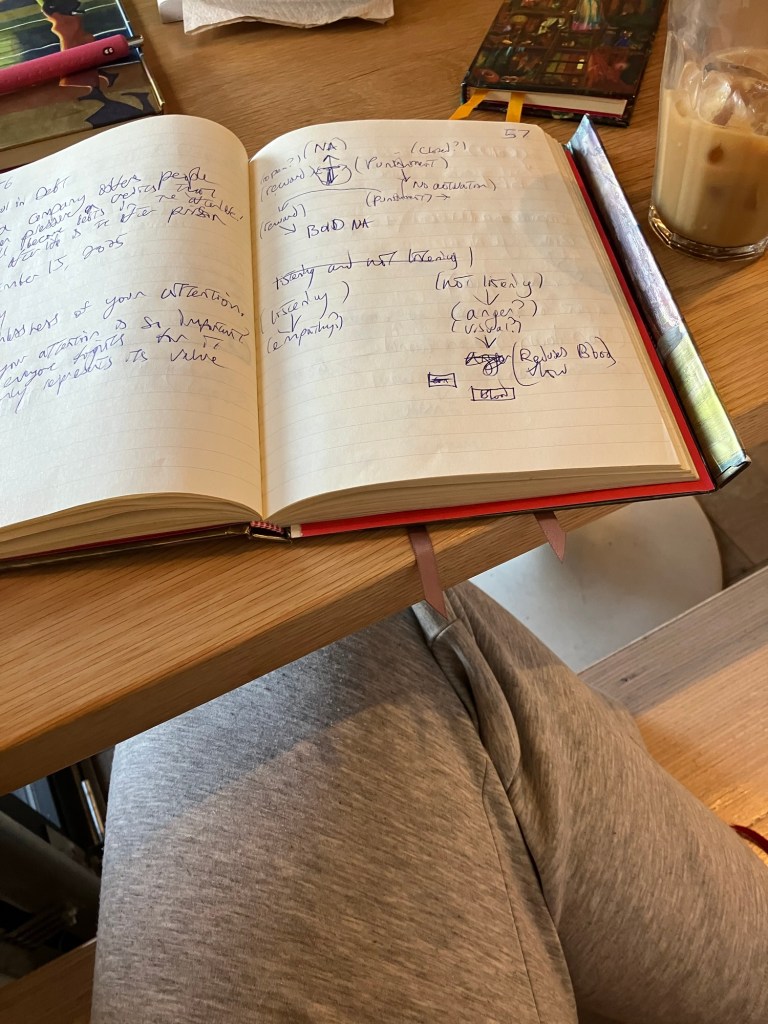
The first studies I attempted to read on ASMR were on precisely what sounds are most likely to cause ‘brain tingles’ or ‘social tingles’ (that’s what they really are. They are social tingles)
Honestly I got pretty bored of that pretty fast. Because the ‘tingle’ was not what I was interested in when I started researching ASMR.
I didn’t even know the tingle was a thing.
What I was interested in was the anticipation and satisfaction of ASMR. I thought I could relate it to writing.
But I was thinking of ASMR in the current AI way which is very different than what they called ASMR in the early 2010’s which were all videos completely focused on helping people feel the social tingle.
The studies that started to catch my interest, the ones I actually read through, (I’ll give specific papers I read and all that in a later post. This is a rough draft of note compiling) had to do with how ASMR affected the brain. Regardless of tingle or no tingle.
Just purely the effects of listening to and watching ASMR videos or listening to what was considered ASMR sounds.
All the papers I read I found using AI. Reading the papers for myself instead of letting AI summarize them was very important.
It’s important because I’m better at filtering out information than AI is.
By attempting to read the actual papers I can let boredom steer me away from information and interest steer me towards information.
Even if I don’t fully understand information or even barely understand it at all, I’ll start to make my own associations and form my own questions and dive deeper into random tangents that can later end up being helpful.
If I let AI summarize everything or just look for little facts to memorize then that process gets skipped.

Of course I ran into a ton of information I did not remotely understand.
Terms I had to run through AI to even know what the hell I was reading.
What got me most stuck in the beginning was trying to understand how an fMRI works.
The first study I read with actual interest involved using an fMRI to map which parts of the brain were lighting up when watching and listening to ASMR versus only listening to ASMR.
I could not wrap my head around how an fMRI worked.
Everyone reading this has to keep in mind that I am very uneducated.
I did rotten in school.
I tuned everything out and even the things I listened to I never fully grasped.
In my high school years I was homeschooled and I did a bit better with that than I had with school teachers. But I was still pretty behind most the kids in my curriculum.
I’m perhaps farther behind most people in the sense that I’m missing a lot of basic knowledge. Which I consider an extreme advantage in life (we can debate that later. In a separate post)

I gave up on reading ASMR studies for a bit and I instead started reading about the fMRI.
It’s very hard to learn or understand anything without any associations.
Like, I can learn that fMRI stands for Functional magnetic resonance imaging.
I can learn that functional abbreviated by f is what differentiates it from an MRI. So rather than mapping structure like an MRI the fMRI is mapping function. Okay, that makes sense.
But then I got into how the magnetic refers to the magnetic field and the resonance refers to the signal being received and imaging refers to the image being created by the signal.
But what signal? How is it getting this signal? I don’t actually know what a magnetic field is. I know people talk about what it is and write about what it is. I know the general information of what they all think it is.
But I have no associations of it for myself. I have no way to relate to it so for me it’s just a very abstract idea.
I tried to go into the history of mapping brain activity to see if that would give me a deeper understanding.
The first method was the electric electroencephalography. Or, E.E.G. (I tried to figure out why it’s called that. Because it’s Greek for electric brain drawing.)
The electric brain drawing machine is this alien helmet looking thing I’d seen before on a tv show somewhere that I didn’t know was actually real.
It detects some kind of electric thing. That I now understand. But when I first looked into it, I did not understand.
After the E.E.G there was the magnetoencephalography. Magnetic brain drawing.
After that there was the positive emission tomography. Which got a bit weirder.
Instead just putting on a weird helmet or getting into a machine with the positive emissions tomography radioactive compounds get injected into the blood stream. It mimics glucose uptake in the active areas of the brain (which I did not understand when I first started studying this but I do now. And the way I came to understand it was very random)
Then something complicated happens, something to do with electrons and protons colliding (I still don’t know what that means) and admitting gamma rays (because of the collision? I still don’t get it) that the PET scanner can detect.
The PET felt so creative to me. (I have the exact detailed notes somewhere of who discovered this and when and why) Like someone got a bit more convoluted in their problem solving ideas than they needed to.
That was what was most interesting to read about. Why these things brain mapping machine were originally invented.
E.E.G guy from example wanted to prove people were telepathic.

Really it’s pretty basic problem solving.
After reading about all these machines and these ‘scientists’ that invented them I started to think of scientist not as smart people, but as children.
Like the kids I used to baby sit that were always trying to figure out how to get past the child locks and get a hold of the one thing they weren’t supposed to play with.
I think most scientists are like that. They just keep poking things until they figure out how to open them.
I think actually most people in general are like that. Nothing but mischievous little monkeys figuring out how to unzip your bags and steal all your stuff.
And I do think it’s adorable.
Human beings are pretty cute, but definitely trouble makers.

How the MRI maps the function of the brain is from a simple little fact. Active areas of the brain consume a lot of oxygen. Which makes sense. We do breathe a lot.
Active areas of the brain consume a lot of blood that has a lot of oxygen in it. So oxygenated blood.
Oxygenated blood and not oxygenated blood (deoxygenated) have magnetic differences which the MRI can detect.
How it detects it is complicated and I don’t really fully understand that yet.
But I do now have an association I can understand. I breathe in oxygen a lot. The brain consumes that oxygen to work. The MRI machine can detect the difference between oxygenated blood and deoxygenated blood. That’s how it creates an image of which parts of the brain are working in relation to which activities.
Alright. Makes sense now.
 Jess lanai